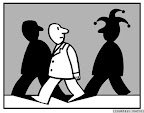
Georg Franck, Economy of Attention :
From his Principles of the New Economy:
Cyberspace is where the new kind of economy comes into its own. Like any economy the new one is based on what is both most desirable and ultimately most scarce, and now this is the attention that comes from other people.
Attention is scarce because each of us has only so much of it to give, and it can come only from us -- not machines, computers or anywhere else.
An economy has to be based on something that is fungible, that is that can be passed along, and one thing about cyberspace -- e.g., the web -- is how conveniently you can pass on attention through hyperlinks.
Not everyone can attract the same amount of attention. Some of us are stars, but most just fans.
The more you pay attention to someone, the more that person is etched in your memory, and the easier it feels to pay still more to her.
So, roughly, your attention wealth = size x attentiveness of your past and present audiences.
Unlike the old matter-based wealth, the new wealth is nothing you can hope to put under lock and key. You get it by reaching out into the world.
Wealth therefore comes to you by expressing yourself fully. The best guarantee you have for attention going to you for what you do is living your life as openly as possible, expressing yourself as publicly as possible as early as possible (hence it makes sense to put out drafts, early versions, so there are witnesses for everything you do.)
Also you accumulate attention through the full extent of your personality --everything that makes you distinctly you and not someone else...
So the new privacy and the old are direct opposite. The new privacy means having no secrets, which you don't normally need to have, because little that was previously shameful or had to be concealed is so now...
What people do demand as privacy now is freedom from having to pay attention, not from being seen but seeing what they don't want to.
and
... 600 files : idiotopedia [ while directing "R/G are Dead" I thought that this dictionary writes Guildenstern for his partner in life Rosencrantz, but, of course it me, Ant, who writes it. diary.vtheatre.net/2008.0 ]
... "ready emotions" and advertising? I am laughing, I am crying, I am enjoying, I am sad, I am upset, I am interesting, I am looking, I am hearing, I am speaking, I am showing, I am, I am, I am... how many?
picasaweb album -- my children books and emoticons :
... youtube.com/anatolant [ which playlist? ] + anatolant.vodpod.com -- I have to think about it, and re-read my own writings (POV & TECH). I thought 600 "emothoughts" is just a theory!
Well, well...
... 2007 = web-year
... and Project #2008 [diary.vtheatre.net] Russian/English
How the new projects contibute to Film600?
I am going down -- I have less respect for human race with each new year.
Perhaps, because I lost respect for myself.
Not beauty, but ugliness grows...
The "middle" -- mediocracy.
Time to say it -- each day "we" are closer to MACHINES. We are never will be perfect machines. Robots always will be better machines. As animal are better animal than humans.
But -- we are better in evolving!
Merry Xmas, cybers, and Happy New 2009 Year!
youtube.com video is gone! "numbers" [ digital human? ] What is a false promice -- I cannot use the clips on my pages as I hoped for. Bad for this 600 pages.
... captions do not make sense anymore.
Semiotics, or semiology, is the study of signs and symbols, both individually and grouped in sign systems. It includes the study of how meaning is constructed and understood. Semioticians also sometimes examine how organisms make predictions about and adapt to their semiotic niche in the world (see semiosis). Semiotics theorises at a general level about signs, while the study of the communication of information in living organisms is covered in biosemiotics or zoosemiosis.
Our challenge as consumers in the age of paid search and performance marketing, therefore, is whether/how to wrest control back from the machine that has begun to anticipate our intentions for its proprietary gain. As Norbert Weiner warned in 1950, in the Introduction to the first edition of The Human Use of Human Beings:
Control, in other words, is nothing but the sending of messages which effectively change the behavior of the recipient... I wish to devote this book to a protest against this inhuman use of human beings; for in my mind, any use of a human being in which less is demanded of him and less is attributed to him than his full status is a degradation and a waste.
I am not sure exactly what attributing full status to a human being looks like on the Internet, but it likely relates to making the value of private gestures public, rather than having them live as secret elements in a black-box algorithm. A few weeks ago I mothballed my Sidekick and decided to live without wireless email for the first time since I got my RIM pager in 1998. The decision was related to my desire to control my attention which had gotten splintered beyond repair in a continuous wireless communication environment.
The human element of web development has been well covered in the business press as emerging in tags, wikis, social networks and other forms of social media. As big as the Internet has become, there is less and less content being consumed on the Internet and more and more of it being created. Increasingly, pages are being built dynamically, on the fly. Such pages are based on the explicit/implicit interests of the user as understood by publishers and advertisers. This is distinct from the traditional model of reading, where one consumes something that already exists. In this new case, what is to be consumed by the user is only created once the user has already expressed his interest (based on where he came from, what he was looking for, and what patterns of behavior might be relevant from his past).
The choruses of attention, data, privacy and identity are all converging in one giant conceptual mashup, which stretches from Web 2.0 pundits to members of Congress grappling with identity theft regulation. Lost at times are the basic rights we are fighting for, which I understand to be:
You have the right to yourself.
You have the right to your gestures.
You have the right to your words.
You have the right to your interests.
You have the right to your attention.
You have the right to your intentions.
http://majestic.typepad.com/seth/2005/07/attentiontrusto.html
[ TrackBack URL for this entry:
http://www.typepad.com/t/trackback/2894460 ]
... Anatoly XXI blog? bloglines?
subjects.txt? I have topics.txt -- what's next? issues.txt? calendar.yahoo.com/anatolant : blogline.com/public/anatolant : 2008
... and? "Not until a machine can write a sonnet or compose a concerto because of thoughts and emotions felt, and not by the chance fall of symbols, could we agree that machine equals brain — that is, not only write it but know that it had written it." - Page 82Robot: Mere Machine to Transcendent Mind
By Hans P. Moravec
Published by Oxford University Press US, 2000
ISBN 0195136306, 9780195136302
240 pages
Forgot to take into consideration that "humans" could stop writing sonnets or do it vey badly.